I stopped writing poetry because it feels like vomiting words in a language I don’t myself understand, from somewhere around backside of my frontal lobe.
It confuses me and feels like I’m trying to say something, but can’t hear my own voice, and can’t know what I’m actually saying.
Even more than usual.
And when it just comes out and I can’t stop it, it reminds me of how a cat looks after coughing out some fur. I just stare at it, and don’t know what is it, what to do with it, and why did it even have to come out.

I also hardly ever read poetry for similar reasons.

Another problem I heave with poetry is that when it ‘comes out’ like a fur ball like this:

look at them hungered eyes
dreaming of soft toes
buried in black soil
look at them burdened skies

 it also ends as abruptly as it came out. And with a feeling that there is nothing else where it came from, like I’m straining to hear what comes next but the sound is not there. But that also for some reason I need to keep it.

The Princess Bride

The Princess Bride by William Goldman

My rating: 2 of 5 stars


This is one of those book I heard about all the time from the very young age, and somehow it kept escaping me until now. Frankly speaking, I now I wish I kept it like that and never picked it up.
This book is like a ball of sharp rusty spikes hidden in a colorful cloud of cotton candy.
It lures you in with rumors and positive mentions by other people in their fiction and fanfiction (though, tbh, I think most of the time they are talking about the movie), it fools you with brilliant glitter of its writing, and genius of dialogs and descriptions. There are a lot of great things about its writing. But then you reach the story.
The story, that features an imbecile heroine, multiple psychopaths with a Zoo of Death (yes, a place where they torture and murder all kinds of beings for fun), hero being tortured physically and mentally to death for loving an imbecile, a cocktail of many of the worst things about humanity, and all ‘friendly’ characters dying at least once… like death is a fun joke. Basically, all the things you really don’t need in your life. The ‘gore and death for everyone, for fun!’ style I simply can’t stand.
After I finished this book, I sat there and imagined what it would be like if you’d take just the story and write it down in the ‘okay’ modern standard style of writing, and I realized I would give it 1 star and throw it into the trash, which I don’t do to books, period. But that’s just how this story made me feel.
If you strip it out of its shiny writing, it’s a terrible, terrible book.


View all my reviews

Nightchaser (The Endeavour Trilogy)

Nightchaser by Amanda Bouchet

My rating: 5 of 5 stars


Space pirates, romance, found families

I’ve been looking forward to his book a lot. I do love stories about outlaws in space, especially with a dose of quality romance, even if it was a bit too instantaneous for my personal preferences.
I wouldn’t say this book is without issues – I feel like there could be a bit more of environment/world building; it felt like the book was too short and covered too little – like an introduction that opened a lot of questions and not much else; it asks you to swallow a lot of ‘…but what about this/but why?’; it leaves a lot of characters and interactions out for no reason; the oppressive tyrant image is a bit too tired. And so on.

Nevertheless, even though there’s plenty of angst, it’s exiting and well-written, and the characters all promise to be interesting. There are books, cats, and handsome rogues. What else needs to be said?

‘Wanting more’ is a good thing, but the fact that this was considered ‘enough’ for this book worries me a little. I hope we’ll get more sustenance in the next one, even though it will have to wait for a year.


View all my reviews

Warsworn (Chronicles of the Warlands, #2)

Warsworn by Elizabeth Vaughan

My rating: 2 of 5 stars


Excessively angsty, and so deeply unsatisfying it hurts

I honestly hoped to be able to give this book a higher review. I even thought I could dedicate a full star just for the letters from Simus… but that’s just it. Those letters are literally the only enjoyable thing about this book, and there are very few of them…
This book deals with sickness and death for its entirety. It heavy, it’s full of angst, and negative emotions I didn’t need to experience. There is too much faceless death, and also death that hit too close to home.
I can’t really say anything negative about the writing or world/character building.
It’s just that the decisions that were made regarding the events and directions of this book are so very deeply unsatisfying, unreasonable, and hateful.
And the negativity goes on and on. Just as you think that it’s about to let up, something bad happens again. And then again, but worse. And it continues in that manner all the way to the end. And even when you think something good is finally about to happen, someone prevents it. The characters that used to bring joy are mostly gone in one way or another. And there were many frustrating moments where much reasonable things could be done and said to stop more bad from happening, but they for some reason’t weren’t.
It feels as if the author was in a very dark place of mind, and then took it all out on this book and us, unsuspecting readers who thought we were reading a fantasy romance. Which is understandable, but not appreciated.
While I had already read the first book twice, and am likely to read it again sometime, I really don’t think I will ever want to put myself through torture of reading this volume ever again. (Maybe only Simus’s letters…)


View all my reviews

Changeless (Parasol Protectorate, #2)

Changeless by Gail Carriger

My rating: 2 of 5 stars


I have very mixed emotions on this.
If I could tear away the last few pages of this book and forget they existed, I probably would have given this book 4-4.5 stars.
The angsty hook/cliff hanger in the end deserves big minus points because a) no one likes them tricks that are designed to push you to get the next book; b) it spoils the taste of the whole book; c) it’s just a dirty move and it gave me entirely too many unnecessary negative emotions.
Seriously though, what the point of ending your book on a note that makes the reader feel like shit?
It threw me off so much I’m having hard time remembering anything good about the book itself, which is unfortunate, because I was pretty sure I was enjoying it.
One positive thing I can say is that the writing style seemed to improve, and there was marginally less of ‘head-hopping’ that made me dizzy in the first book.
Another unfortunate point is that I could help but feel like Ivy’s personality underwent a change to worse. Maybe my impression after the first book was erroneous, but in ‘Soulless’, Ivy read as an eccentric but an interesting character, even with some degree of understanding and thought, that would explain them being friends with the MC. In ‘Changless’, however, she was turned into a ‘annoying simpleton with the worst possible timing’.
Also, entirely too many annoying females for one short book, inho.


View all my reviews

One of the worst things about lasting anxiety attacks is that they often lock you into the place/state you are in, taking away your chances to take a breath and recover.

When you’re already ‘barely hanging on’, you will always instinctively choose the path of least resistance = the path that will bring less new anxiety. Which will also meant sticking to the ‘normal’ or the ‘routine’ that brought you into the place with anxiety in the first place.

For example, if you had your anxiety attack start during the night and last almost all the way till morning, preventing you from sleeping and making you feel like shit when you’re alarm trying to get you up for work, it would be a logical decision to call in sick and rest at home for a day, or at least take first half of the day off. However, the amount of anxiety involved in ‘picking up the phone to call work and tell them that you’re not feeling well and will take a sick day’ involves 2-3 times more anxiety than ‘make yourself get up and go to work as usual (even though there are people there)’. So you get up, no matter how bad you feel. Because, chances are, the worse you feel, the less chances there are to find strength to pick up the phone.

The same happens when you’re already at work and have an attack there. On one hand, you’re clearly not well, and your body tells you that it can’t continue on, and you need to get out. On the other hand, breaking the ‘everyday normal’, getting up to explain to people that you need to go home, bringing attention to yourself by doing all that, too often feels like something that will bring more anxiety than you can already handle. So again you sit there trying to imagine which is worse.

Getting out of your anxiety attack by yourself is very difficult, because it feels like quicksand – as in any kind of struggle you imagine attempting seems like it will only suck you deeper. It feels safer to stay still where you are and save your energy. And it’s really hard to know which of the options is actually the correct one this time around.

Radiance (Wraith Kings, #1)

Radiance by Grace Draven

My rating: 4 of 5 stars


I thought I’ll love this book when I reached the part where human appearance was described from the ‘outside’ eyes in all its ugliness. I liked the touch.
In the end, I did love some things about this concept, but I can’t say I 100% believe that it was executed to its full potential. I feel like there was a big stress on differences between races regarding concepts of beauty, and such things as food, but then we hardly got to see any substantial cultural differences. I feel like there are human cultures that have more behavioral differences than humans and Kai have, and in that respect I feel like the concept was underdeveloped.
Also, in our day and age(of watching all kinds of aliens and fantasy races on tv), I do find this idea difficult to actually believe… Should we have been imagining Kai to look like Uruk-hai so it would be easier to get behind the idea of humans being repulsed by their appearance? Otherwise, I didn’t really find much reasons in the descriptions to understand why were they considered ugly by humans.

And minus points for the bloody ending. I find it’s very unfortunate where the ending makes you not look forward to the sequels.


View all my reviews

Last year, I actually went and printed off my whole ello blog with the intention of re-reading it from the beginning. 
At first I thought that it was because it’s a thing I do when it’s Spring, and my birthday (and trip back to Europe) was near and my memory is shit (also because I just did a similar thing with someone else’s blog). 
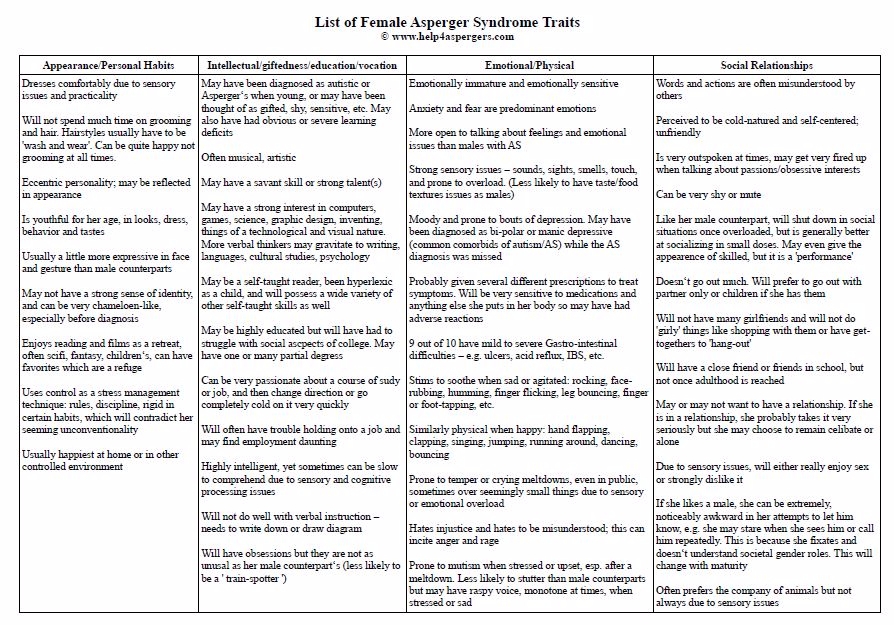
But actually reading it, I understand that it just falls in with the stage of looking back and reconsidering things I did and said with my new understanding of my diagnosis. It’s a little staggering… to see it everywhere now. To see myself describe compulsions, patterns, sensory overload problems, and never examine them, never see them for what they were, until now.

I’m trying to very cautiously consider the real differences between human behaviours of ‘accepting’ and ‘not caring’.

I read that title as ‘The Greatest Snowman’ every single time, and get surprised by it every single time
But why.

probably because there’s not enough snow in my life

Every day since learning the diagnosis has more or less been: I still have no idea why/what xxx (insert an aspect of human behavior largely considered normal) is, but now at least I feel marginally less pressure to understand.

Rudy Simone, Aspergirls :


To find out you're autistic is quite a realization to have in your teens, but in your 40s or 50s it means you have to look back at your whole life and re-frame everything; every incident, every moment, with this new lens to look through. It's like getting glasses after spending your whole life near-sighted. Obviously, the longer you've gone without the diagnosis the more work you have to do in looking back. And in some cases, the more damage to your spirit, psyche, and relationships you have to undo. There are stages we have to get through once we, as adults of any age, find out we have Asperger's:
* Awareness - We find out about Asperger's and the information speaks to us but it just hasn't hit home yet. We may experience some resistance or denial.
* Knowing - The irreversible understanding that you have Asperger's. The realization clicks.
* Validation - Asperger's explains so much in a life that often seems to have had no rhyme nor reason. This is not one moments that will continue for years if not forever.
* Relief - I can finally as the song says "Lay my Burden down". We don't know what our burden is until we're diagnosed but we can tell that other people don't seem to be carrying it.
* Worry - What does this mean for my future and my potential?
* Anger - For all the blame and misdiagnoses that may have been laid upon us by others or by ourselves. Hopefully we will then get to the next phase of our lives.
* Acceptance/thriving - We become keenly aware of our gifts and deficits and use what we have wisely.


I don’t know if I’m doing this in order, but I’m pretty sure I’m hovering somewhere around anger mostly.

This past year, I’ve been trying to read some books on Asperger’s, but wasn’t really able to do a good job of it.
I just can’t seem to handle it. I’d like to hope, ‘yet’.
I read articles and impersonal descriptions online just fine. And I have Tony Attwood’s book too, and perhaps I should have tried to read that one first…
But the full “Guide to Aperger’s” is big and serious, and I thought I’d ease myself into it by reading much thinner personal accounts… like “Pretending to be Normal” Liane Holliday Willey or even “Aspergirls” by Rudy Simone… and that’s where I thought wrong. I don’t know if I’m just too bitter right now, or am constantly in an unstable place.

Reading about mildly confusing but generally supported childhoods gets me angsty and snuffling after every paragraph, even when I later read that usually the difference is only that what I went through in elementary/middle school, others still went through, but perhaps somewhere closer to college age. But then the chapter when she begun talking about friends had me in tears 2 seconds in and I almost flung the book against a wall as hard as could… which was rather unfortunate because I also for some reason thought that reading it in small portions during lunch at work would be a good idea.
Whatever it is, I can hardly read these personal accounts without getting frustrated or tearing up, and there’s nothing good about these tears. They are no tears of relief, sympathy, or empathy. They are bitter, and resentful (even if not towards the words and those who wrote them), and exhausted. And I really don’t like myself like this. I don’t want to be this person tearing up 20 times a day from some kind of self-pity or what is this even. I think Simone wrote in the Introduction how it made her exited to read these accounts by other women, because they finally allowed her to recognize herself in others, or identify with someone, and I get that. And I wish I could feel like that too. I wish I would just read these to learn more about others and myself, to maybe even get some hints that could help working through it, to understand things a little better. The problem is, is while I can identify with most of related issues, and am perfectly aware of the fact that each person is different and even if share some one ‘thing,’ there is no way for any other experiences to have any overlap, I still… just can’t handle it, apparently. And it is not really about perceiving my experiences ‘worse’ than the way someone else had it. Though, to be honest, I don’t even know what is this about, really.
And there are plenty of people who are not diagnosed until well into adulthood, and say things like ‘I wasn’t diagnosed until my child was,’ but I’m still in that bitter corner where I just want to narrow my eyes and say “yeaaah, the point is you still managed to get married(likely) and have those children though, didn’t you?” And the marriage and children is not the point, it’s the fact of being on the ‘inside’ of the human society, and having enough social abilities, where you’re even able to do things like that.
You can’t break down if you’re already broken throughout. And you can’t lose your shit if you don’t have your shit together consistently.

It caught me a little off guard with how simple and true this is.